|
Electronic Components Datasheet Search |
|
|
Electronic Components Datasheet Search |
|
ISL41334IRZ Datasheet(PDF) 19 Page - Intersil Corporation |
|
|
|||||||||||||||||||||||||||||
ISL41334IRZ Datasheet(HTML) 19 Page - Intersil Corporation |
|
|
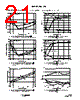
19 / 28 page  19 FN6202.3 November 21, 2007 RS-485 Slew Rate Limited Data Rates The SOIC and SSOP versions of this IC operate with Tx output transitions optimized for a 20Mbps data rate. These fast edges may increase EMI and reflection issues, even though fast transitions aren’t required at the lower data rates used by many applications. The ISL41334 (QFN version) solves this problem by offering two additional, slew rate limited, data rates that are optimized for speeds of 115kbps, and 460kbps.The slew limited edges permit longer unterminated networks, or longer stubs off terminated busses, and help minimize EMI and reflections. Nevertheless, for the best jitter performance when driving long cables, the faster speed options may be preferable, even at lower data rates. The faster output transitions deliver less variability (jitter) when loaded with the large capacitance associated with long cables. Figures 43, 44, and 45 detail the jitter performance of the three speed options while driving three different cable lengths. The figures show that under all conditions the faster the edge rate, the better the jitter performance. Of course, faster transitions require more attention to ensuring short stub lengths, and quality terminations, so there are trade-offs to be made. Assuming a jitter budget of 10%, it is likely better to go with the slow speed option for data rates of 115kbps or less, to minimize fast edge effects. Likewise, the medium speed option is a good choice for data rates between 115kbps and 460kbps. For higher data rates, or when the absolute best jitter is required, use the high speed option. Speed selection is via the SPA and SPB pins (see Table 3), and the selection pertains to each port programmed for RS-485 mode. Evaluation Board An evaluation board, part number ISL41334EVAL1, is available to assist in assessing the dual protocol IC’s performance. The evaluation board contains a QFN packaged device, but because the same die is used in all packages, the board is also useful for evaluating the functionality of the other versions. The board’s design allows for evaluation of all standard features, plus the QFN specific features. Refer to the eval board application note for details, and contact your sales rep for ordering information. Typical Performance Curves VCC = VL = 5V, TA = +25°C; Unless Otherwise Specified. FIGURE 14. RECEIVER OUTPUT CURRENT vs RECEIVER OUTPUT VOLTAGE FIGURE 15. RECEIVER HIGH OUTPUT VOLTAGE vs LOGIC SUPPLY VOLTAGE (VL) FIGURE 16. RS-485, DRIVER OUTPUT CURRENT vs DIFFERENTIAL OUTPUT VOLTAGE FIGURE 17. RS-485, DRIVER DIFFERENTIAL OUTPUT VOLTAGE vs TEMPERATURE 0123 45 0 10 20 30 40 50 RECEIVER OUTPUT VOLTAGE (V) VOH, +25°C VOH, +85°C VOL, +25°C VOL, +85°C VL (V) 0123 45 0 1 2 3 4 5 IOH = -1mA IOH = -4mA IOH = -8mA DIFFERENTIAL OUTPUT VOLTAGE (V) 01 23 45 0 10 20 30 40 50 60 70 80 90 100 -40 0 50 85 TEMPERATURE (°C) -25 25 75 RDIFF = 54Ω RDIFF = 100Ω 3.0 3.1 3.2 3.3 3.4 3.5 3.6 ISL81334, ISL41334 |
|
Link URL |
| Does ALLDATASHEET help your business so far? [ DONATE ] |
About Alldatasheet | Advertisement | Contact us | Privacy Policy | Link to Datasheet | Link Exchange | Manufacturer List All Rights Reserved©Alldatasheet.com |
| Russian : Alldatasheetru.com | Korean : Alldatasheet.co.kr | Spanish : Alldatasheet.es | French : Alldatasheet.fr | Italian : Alldatasheetit.com Portuguese : Alldatasheetpt.com | Polish : Alldatasheet.pl | Vietnamese : Alldatasheet.vn Indian : Alldatasheet.in | Mexican : Alldatasheet.com.mx | British : Alldatasheet.co.uk | New Zealand : Alldatasheet.co.nz |
|
Family Site : ic2ic.com |
icmetro.com |
 English ▼
 English
 Chinese
 German
 Japanese
 Russian
 Korean
 Spanish
 French
 Italian
 Portuguese
 Polish
 Vietnamese
 Indian
 Mexican
 British
 New Zealand